
The Future Of Media
Voices that reveal the truth: Winners of the 2025 Maria Moors Cabot Prizes reflect on their journeys
27 / 11 / 2025

27 / 11 / 2025
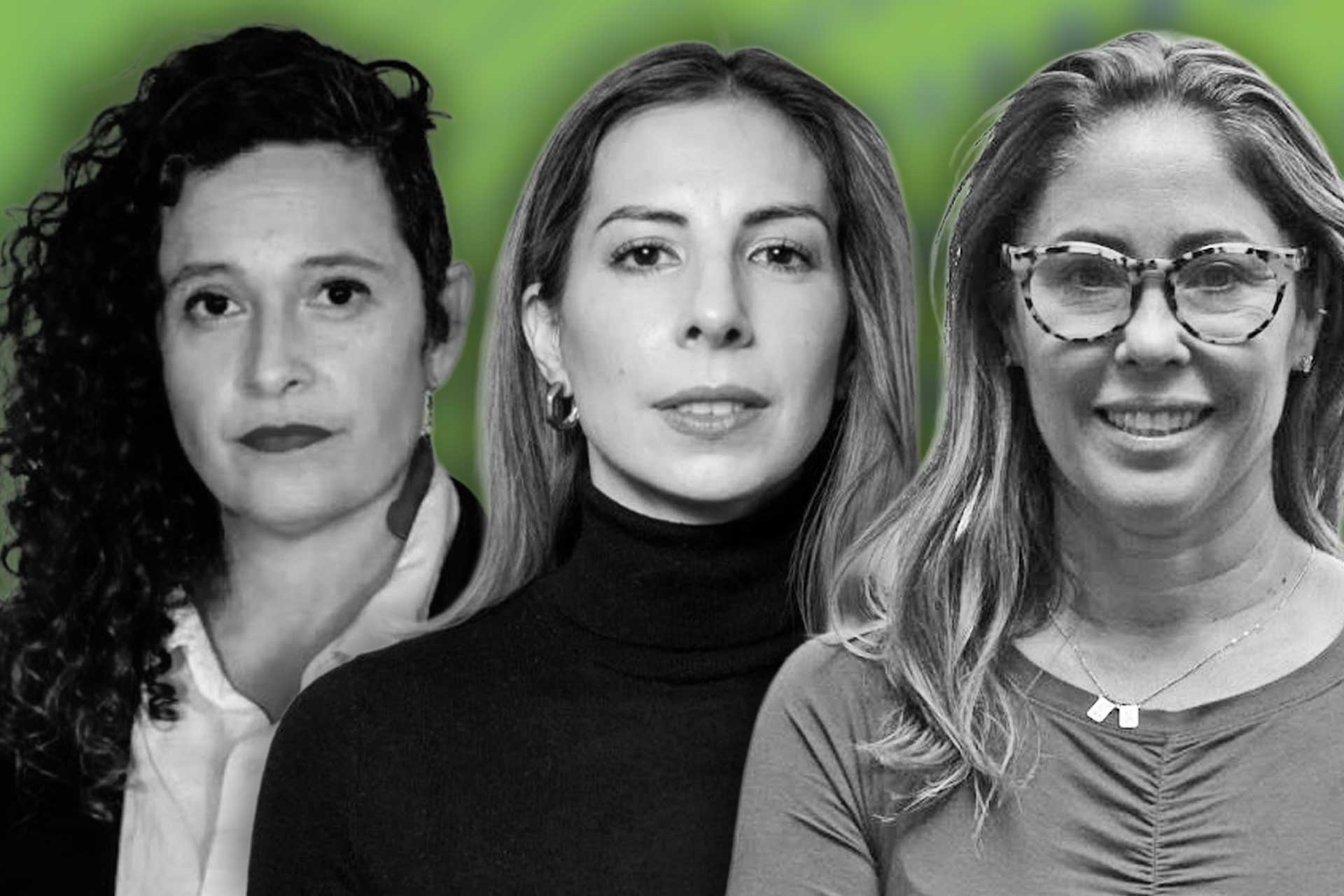
We spoke with the protagonists of the 87th edition of Columbia University’s Maria Moors Cabot Prizes, one of the most prestigious awards in global journalism. Three of the four award winners that shared their experiences are Natália Viana, co-founder of Agência Pública (Brazil); Isabella Cota, member of the International Consortium of Investigative Journalists (Mexico); and Omaya Sosa Pascual, co-founder of the Center for Investigative Journalism (Puerto Rico) | By Antonia Baeza and Ignacio Vera
In the main hall of Columbia University’s Italian Academy, the sound of voices and the clinking of silverware filled the air. The room was packed with guests. There were professors, staff members, students, and relatives of the award winners. Suddenly, the lights dimmed and a voice echoed through the speakers. Jelani Cobb, dean of Columbia University’s Graduate School of Journalism, began the event’s opening speech. After a few introductory remarks, he stated that nowadays in the United States “speaking Spanish in public has become a political act,” and continued the rest of his speech in that language.
The Maria Moors Cabot Prizes are the oldest international journalism awards. In their eighty-seventh edition, for only the second time in history, all four awardees were women. And for the first time, they were all Latin American professionals, three of them Spanish-speaking. The Maria Moors Cabot Gold Medal was awarded to these Latin American women in recognition of their professional excellence and outstanding careers in investigative journalism.
The dean’s remarks were followed by the presentation of the honorees. Four journalists from across Latin America whose careers have been defined by investigative work, editorial independence and the defense of press freedom. Next, Brazilian journalist Natália Viana, co-founder of Agência Pública; Mexican journalist Isabella Cota, member of the International Consortium of Investigative Journalists; and Puerto Rican journalist Omaya Sosa Pascual, co-founder of the Center for Investigative Journalism, share the challenges, lessons and convictions that have guided their work.
September 2008. The financial world was collapsing amid the bankruptcy of the world’s largest investment firm, Lehman Brothers. It was the beginning of the most severe financial crisis since the Great Depression, but also the start of Isabella Cota’s passion for economic journalism.
Only a week had passed since the start of her master’s program in Denmark when the news sent shockwaves through the global economy. “My professors, who were some of the brightest minds in Europe in the fields of communication and journalism, couldn’t even explain to us what was happening in the world,” Cota recalls, sitting on the grass of Columbia University’s campus. Amid the confusion, one thing became clear to her: to understand the world, she needed to be able to decipher it through finance.
Ver esta publicación en Instagram
Seventeen years have passed since that moment, and since then, the Mexican journalist has dedicated her career to explaining how the economy shapes people’s lives. Her work ranges from uncovering market forces to exposing corruption in her country.
In 2021, Isabella Cota and her partner Adam Williams, who is also a journalist, published an investigation that she considers the most important of her career. Working independently, they revealed how a U.S. company, just a few days old on paper, began receiving multimillion-dollar contracts from the Mexican government to market natural gas.
“If you think about corruption in its broadest definition, well, conflicts of interest in the use of public funds are corruption,” the journalist explains. According to Cota, “Mexican taxpayers’ money was being used to sign $15 billion contracts over 25 years with a company that stood to profit.”
The impact of the investigation crossed borders: a federal court in Texas opened a civil case against two officials, both accused of corruption. The trial will begin “next year, if everything goes as planned, where it will be decided whether there was corruption or not, at least in the eyes of U.S. law,” the journalist explains.
But behind every investigation, Isabella feels “a certain tightness in her chest.” Since the year 2000, around 140 Mexican journalists have been killed, according to Reporters Without Borders. The same organization has described Mexico as the most dangerous country that is not at war in the world for journalists.
“I had no way of knowing that the country would fall into the spiral of violence it has,” Isabella says in a trembling voice. Behind her glasses, her eyes well up, but the tears never fall. She repeated those same words the following day during her award acceptance speech.
Even though the consequences of her work are dangerous, she continues: “On one hand, I simply can’t not do it, it’s who I am, and on the other, because this fight makes perfect sense to me”.
From New York City, after a long work meeting, Natália Viana recalls her first steps in journalism. Although she speaks a bit of Spanish, she prefers to continue the conversation in English, the language she feels most comfortable in, aside from Portuguese.
Her first steps in journalism began at university. “I covered human rights violations and very profound stories. That’s what has always driven me,” Viana says. It was the political and social context of her country that pushed her to stay in the profession: “Brazil is one of the most unequal countries in the world. I was looking at the numbers yesterday. The top 1% of the population owns, I think, about 26% of the wealth”.
Ver esta publicación en Instagram
Those numbers are reflected across Brazilian society: from residents of the favelas to the population known as the quilombos, descendants of enslaved people. However, one group proved especially important in shaping Viana’s career: the Landless Workers’ Movement (Movimento dos Trabalhadores Rurais Sem Terra).
“It was very important to meet the people doing this work, because they were seen as criminals, as land invaders. And it was really enlightening to understand that these were basically poor people who were deeply aware of their rights, like the right to live and the right to land,” Viana explains.
Fifteen years ago, Viana co-founded an independent media outlet called Agência Pública, specializing in investigative journalism. The journalist explains that the outlet “has won more than 85 national and international awards. So we earned our reputation basically by demonstrating the quality of our work.” Regarding funding, she clarifies that “it’s very similar to human rights organizations that don’t do journalism. Which means we rely on foundations and individual donors who make our work possible.”
Nevertheless, Viana has faced many challenges throughout her career. “Brazil is a very sexist society, so the fact that I’m a woman changes everything,” she argues. “It changes the way sources talk to you, especially men and particularly those in positions of power. There make more online threats because they think they can intimidate you. They ask more questions to make others think you don’t know what you’re talking about,” she recounts.
One of her most notable works is the report San Gabriel and Its Demons, in which she investigates why the area with the largest Indigenous population in the Brazilian Amazon also has the highest suicide rate. To report from São Gabriel, she had to travel four hours by plane and three days by boat, according to the Gabo Festival, the same foundation that awarded her a prize in 2016 for this story. But the greatest challenge for Viana, she says, “was reconciling the fact that Indigenous peoples have a different concept of health, life, and death, like in the case of a suicide.”
“There have always been difficulties, but I think the magic of journalists is that if you’re truly obsessed, you find a way to survive”, Viana says gently.
“You always find a way to survive”.
In 2017, Hurricane Maria struck Puerto Rico. The storm didn’t just destroy roofs and roads, it also swept away the public institutions’ sense of certainty. Journalist Omaya Sosa Pascual refused to believe the government’s absurdly low official number of victims. Authorities claimed there had been only 64 deaths. Sosa Pascual, co-founder of the Center for Investigative Journalism (CPI), decided to investigate on the ground, searching for the names of the missing people who didn’t appear in government records. House by house, document by document, she demonstrated that the tragedy was thousands of times bigger. Her investigation led the government to officially acknowledge nearly three thousand deaths. Since then, she has continued working in independent media outlets she founded herself. Sitting in front of Pulitzer Hall at Columbia University, Sosa Pascual asserts: “Journalistic truth must be independent. Everything else is propaganda”.
Ver esta publicación en Instagram
The disaster transformed her career. “We started publishing six days after the hurricane,” she recalls. “We sued the government, reviewed death certificates and interviewed nearly five hundred families,” she continues. What began as an individual effort evolved into a collaborative investigation involving more than 30 journalists from the CPI and international media outlets such as Quartz and the Associated Press. It was the first time a Puerto Rican journalistic project reached global coverage.
Two years later, Puerto Rico was shaken again by another CPI revelation: the RickyLeaks. The leak consisted of 889 pages of Telegram chats between then-governor Ricardo Rosselló Nevares and his political allies — or brothers, as he called them. In these messages, the former governor and his advisers revealed partisan strategies funded with public resources, alongside sexist jokes, misogyny and mockery of journalists and social organizations. “The content of the chats was so strong that people had to see it with their own eyes,” Sosa says. “So we decided to publish them in full.” The entire set of chats can be viewed in the original publication.
The report ignited the spark of public outrage. Just days after its release, Rosselló Nevares resigned.
Behind every investigation lies a guiding principle that Sosa defends firmly: independence. “If we’re not independent, we don’t know the truth,” she asserts confidently. She explains that in a small Caribbean island where traditional media depend on economic interests, the emergence of the CPI was a much-needed exception. She recalls that the media outlet began with two part-time journalists earning minimum wage. Today, it has twenty reporters and is part of a network of collaborative investigative media in the Caribbean. The key, she says, has been learning how to sustain a nonprofit newsroom through organizational grants, citizen donations, workshops and events. “We’ve had to learn to run it like a business, but with a much greater purpose: ensuring that information remains public”.
When Sosa Pascual speaks about her work, she does so with the calm of someone who has endured every kind of obstacle. Being a woman, she says, adds yet another layer of difficulty to a profession that is dangerous by nature. “Men think you’re their secretary. When you interview them, they look at you differently, they ask you out in the middle of an interview,” she says with irony. But those obstacles never stopped her. “After going through all that, you become stronger. Nothing scares you anymore.” Today, according to the CPI’s website, four of the organization’s five editors are women. “For sixteen years, the newsroom’s leadership was entirely made up of women,” she says, a clear pride lighting up her face. “We’ve shown that we can lead with rigor, but also with empathy,” she continues.
Now, Sosa Pascual and the CPI face a new threat: the state itself. In 2024, the media outlet published an investigation revealing electoral fraud in Puerto Rico. Sosa Pascual and CPI’s Editorial Director, Wilma Maldonado, uncovered that deceased individuals appeared as having voted in the elections. Instead of investigating the State Elections Commission, Puerto Rico’s Department of Justice launched an investigation against the media outlet, alleging that it had obtained the electoral roll illegally. At this point, however, the journalist says she is well-seasoned in such battles. “We’re used to litigating against the state. We’ve won all thirty lawsuits, more than one per year. They set every kind of trap, every kind of obstacle to keep us from accessing official information. We know that every public document or interview we try to access is a battle we have to fight,” she concludes.


